


Engineering projects rarely fail because of a lack of ideas. More often, challenges arise when decisions are made too early, requirements aren’t fully understood or manufacturing considerations are introduced too late in the design process.
Every engineering decision has consequences, whether you’re developing process equipment or automotive components. Choices made during concept development can influence manufacturing costs, product performance, maintenance requirements and long-term reliability long before production begins.
This is why experienced engineering consultancies such as NOVA Design don’t approach projects as a single continuous task. Instead, we follow a structured mechanical design process that introduces defined review stages, allowing concepts to be challenged and validated before progressing to the next stage.
What Is the Mechanical Design Process?
At NOVA Design, our methodology is built around four key design reviews:
- Preliminary Design Review (PDR) – establishing and agreeing the initial concept.
- Critical Design Review (CDR) – developing that concept into a fully engineered solution.
- Manufacturing Design Review (MDR) – preparing the design for efficient manufacture.
- Technical Documentation Review (TDR) – completing the documentation needed to support production, operation and maintenance.
Together, these stages create a clear pathway from concept through to manufacture, helping projects progress with greater technical confidence and providing clients with clear visibility throughout development.
Why a Structured Mechanical Design Process Matters
Mechanical design is often associated with CAD software and detailed assemblies. While these outputs are essential, they represent the result of the engineering process rather than the process itself.
Every design process in mechanical engineering begins with understanding the problem that needs to be solved.
Before detailed design work starts, engineers need to establish and identify any technical constraints and consider how a product will perform beyond the drawing board. Questions around manufacturing, assembly, maintenance, safety and operational performance all influence the decisions made throughout the project.
Without a structured approach, these considerations can become fragmented. Designs may meet their functional requirements but prove difficult to manufacture or be unnecessarily complex to maintain. Addressing these challenges after detailed engineering has already begun often results in additional design iterations and costly, avoidable delays.
A phased development process reduces this risk by creating opportunities to review progress before major decisions become difficult to change. Each review acts as a checkpoint, allowing engineers and clients to confirm that the project remains aligned with its technical objective before moving forward.
The Four Stages of the Mechanical Design Process
While an engineering project has its own technical requirements, the objective of a structured design process remains consistent: to transform an initial concept into a practical, manufacturable solution through a series of clearly defined development stages.
Rather than treating design as a linear activity, each phase asks a different engineering question before allowing the project to progress.
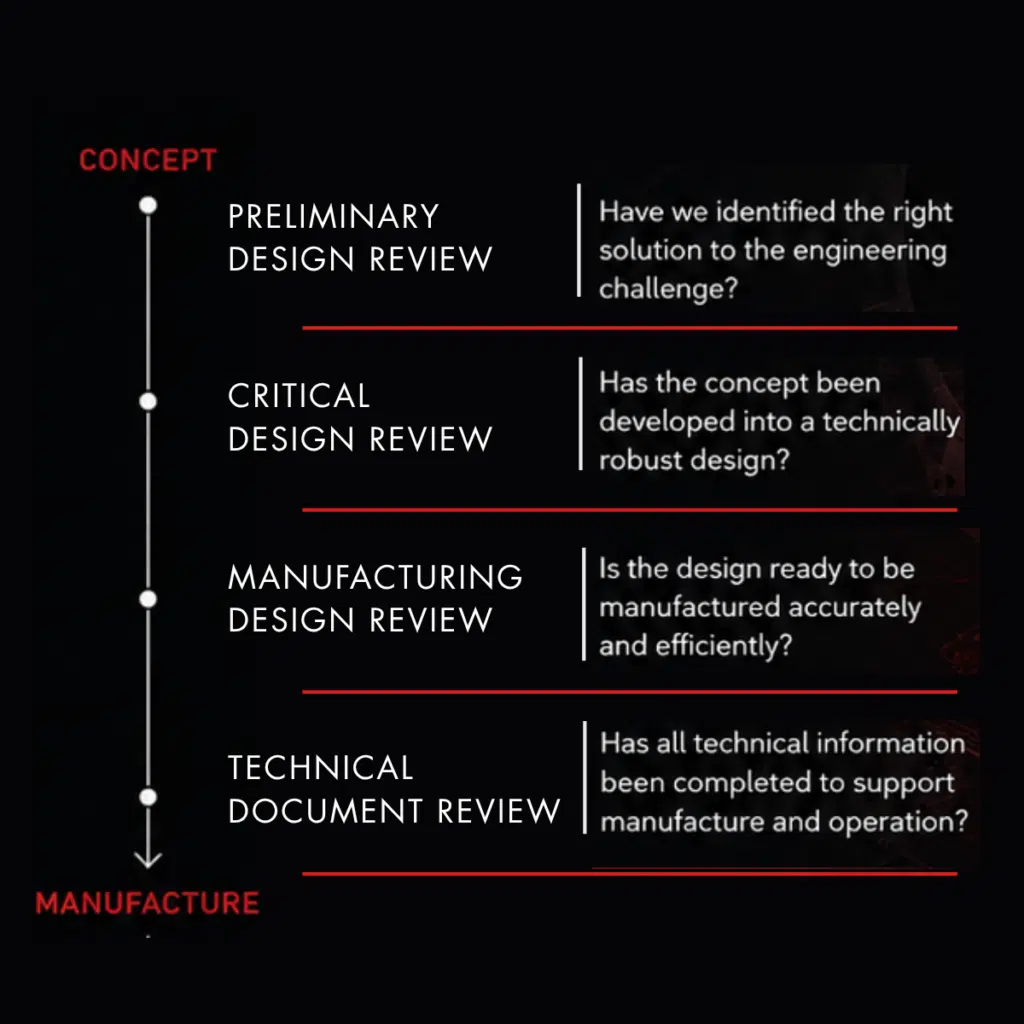
Each review builds upon the previous stage, creating a structured development pathway that supports informed decision-making throughout the project lifecycle.
Rather than focusing solely on the final product, this approach recognises that successful engineering depends on making the right decisions at the right time.
Preliminary Design Review (PDR): Building the Right Foundations
Every successful mechanical product development project starts with a thorough understanding of the problem.
The Preliminary Design Review (PDR) establishes the project’s fundamental direction by defining and agreeing the basic concept before significant engineering resources are committed.
At this stage, the emphasis is not on producing detailed CAD models or manufacturing drawings. Instead, engineers focus on understanding the project’s technical requirements, commercial objectives and practical constraints to determine whether the proposed product design concept is both achievable and appropriate.
A comprehensive preliminary review may consider:
- Functional requirements and performance objectives
- Available installation space or packaging constraints
- Environmental and operating conditions
- Material considerations
- Potential manufacturing methods
- Applicable standards or regulatory requirements
- Project risks and technical uncertainties
By the end of the Preliminary Design Review, clients and engineers should share a clear understanding of the project’s direction, ensuring subsequent design work is built on agreed objectives rather than assumptions.
Critical Design Review (CDR): Developing a Workable Engineering Solution
Once the project’s direction has been established, the focus shifts from defining the concept to developing it into a complete engineering solution.
The Critical Design Review (CDR) transforms the approved concept into a fully workable design scheme through detailed engineering within the wider engineering design process, refinement and technical evaluation.
Rather than asking “Is this the right idea?”, this stage asks a more demanding question:
Can this concept perform reliably, be manufactured efficiently and satisfy the project’s technical requirements?
During this phase, engineers refine the design through considerations such as:
- Component integration and assembly
- Material selection
- Design for manufacture and assembly (DfMA)
- Serviceability and maintenance access
- Safety and operational performance
- Engineering tolerances and interfaces
Manufacturing Design Review (MDR): Preparing the Design for Manufacture
The Manufacturing Design Review (MDR) bridges the gap between engineering design and production by evolving the approved design into a complete set of manufacturing drawings and supporting information.
At this stage, the emphasis shifts from “Will this work?” to “Can this be manufactured efficiently while maintaining the required quality and performance?”
During the Manufacturing Design Review, engineers typically focus on:
- Producing detailed manufacturing and assembly drawings
- Defining dimensions and tolerances
- Confirming material specifications
- Reviewing manufacturing methods
- Identifying opportunities to simplify production where appropriate
- Preparing the information required to support consistent manufacture
A comprehensive manufacturing review helps reduce ambiguity by ensuring suppliers and production teams are working from the same technical information. Manufacturing drawings communicate far more than geometry. Material specifications, tolerances, finishes, notes and assembly information all contribute to ensuring components can be produced consistently without unnecessary interpretation.
Technical Documentation Review (TDR): Completing the Engineering Record
The physical product is only one outcome of a successful engineering project.
The information that accompanies the design plays an equally important role in supporting manufacture, installation, operation and ongoing maintenance throughout its lifecycle.
The Technical Documentation Review (TDR) finalises the documentation required to support the completed design, ensuring technical information is accurate, complete and ready for handover.
Depending on the nature of the project, this may include:
- Technical data sheets
- Risk assessments
- Operation and maintenance manuals
- Installation guidance
- Supporting engineering documentation
Completing this final review helps ensure that knowledge generated throughout the project is retained rather than existing solely within the design team. Clear technical documentation provides consistency across everyone involved in the project. Manufacturers understand how components should be produced, installers have access to the information required during implementation and maintenance teams can refer to accurate documentation throughout the product’s operational life.
Why the Mechanical Design Process Reduces Cost and Risk
Every engineering project presents unique technical challenges, but successful projects often share one characteristic: decisions are made methodically rather than reactively.
For clients, this offers several advantages throughout the project lifecycle:
- Greater visibility into project progress through clearly defined development stages.
- Better alignment between engineering objectives, commercial requirements and manufacturing considerations.
- Improved collaboration through structured review points and documented decision-making.
- Greater confidence that technical information has been developed systematically before manufacture begins.
Importantly, a structured process doesn’t remove engineering challenges. Instead, it provides a framework for addressing them consistently, ensuring every stage of development builds on the work completed before it.
Choosing a Mechanical Design Company
Technical capability is naturally an important consideration when selecting a mechanical design company, but it’s only part of the full picture.
Ultimately, a structured mechanical design process helps transform concepts into practical, manufacturable solutions through clear engineering reviews, robust documentation and collaborative decision-making.
If you’re looking for a mechanical design company that manages every stage of this process, learn more about our Mechanical Design Services our Contact Our Team today.